How Payment Orchestration Works: Architecture and Trade-offs
A technical guide to payment orchestration: routing, tokenisation, retries, reconciliation, cost modelling, and the build-versus-buy decision.
In this research
Payment orchestration is a control layer between a merchant's checkout and its payment service providers, acquirers and fraud systems. It gives the merchant one integration surface while routing each payment according to explicit rules. The useful question is not whether orchestration is fashionable; it is whether a merchant has enough provider, market and operational complexity to justify another critical component in the payment path.
A sound architecture can improve resilience and make provider economics measurable. It cannot turn a hard issuer decline into a valid approval, remove card-scheme retry restrictions, or guarantee lower processing cost. Those outcomes depend on the merchant's traffic mix, contracts and control design.
The components in a payment-orchestration architecture
The entry point is an API or hosted payment component that converts the merchant's payment request into a canonical internal format. That model normally includes amount, currency, payment method, merchant entity, customer context, authentication data and an idempotency key. Provider adapters translate that canonical request into each processor's fields and translate responses back into one merchant-facing status model.
A routing engine evaluates policy. Simple rules select by geography, currency or payment method. More advanced rules can consider provider availability, contracted cost, historical authorisation performance and capacity constraints. The engine should record both the input features and the rule version used, otherwise a later dispute or performance analysis cannot reconstruct why a transaction went to a particular provider.
The token layer is separate from routing. A merchant may use an orchestration-owned vault, provider tokens, or network tokens. EMVCo's payment-tokenisation framework[1] defines roles and requirements for tokens that work across the payment ecosystem. Portability depends on the token type and contracts; moving a stored credential between processors is not automatically possible merely because an orchestrator sits in the path.
Finally, the platform needs event processing and reconciliation. Authorisation, capture, refund, chargeback and settlement events arrive asynchronously and differ by provider. Normalising those events is part of the product, but finance still has to reconcile provider reports, bank movements and the merchant ledger. An orchestration migration that budgets for routing but not reconciliation has only costed half the system.
Routing, failover and decline handling
Routing should distinguish availability failure from payment failure. If a processor times out before a definitive authorisation response, a controlled failover may preserve the sale. If the issuer returns a hard decline, sending the same transaction repeatedly through other acquirers can breach scheme rules, increase fees and create duplicate-authorisation risk.
Visa's published decline-resubmission rules[2] classify response codes and state that transactions in the category where the issuer will never approve must not be reattempted. An orchestrator therefore needs a maintained response-code policy, not a blanket instruction to "retry on decline." It also needs idempotency controls so a late response from the first processor cannot create a second successful charge after failover.
Authentication state must survive routing correctly. In the European Economic Area, the consolidated strong-customer-authentication regulation[3] links authentication to the amount and payee and limits exemptions according to defined conditions. The orchestration layer must pass authentication and exemption data to the selected provider without silently changing the transaction context.
Operational failover also requires live merchant accounts, limits and settlement instructions with each backup provider. A dormant integration that has not processed production traffic recently is not a reliable contingency. Merchants should test controlled traffic through every designated backup and monitor authorisation, latency, dispute and settlement behaviour separately.
Security and PCI scope
Orchestration can reduce the number of places that handle card data, but it does not by itself remove PCI DSS obligations. PCI DSS v4.0.1[4] is the current version of the standard. The PCI Security Standards Council says it manages the standard and assessor training, but that compliance-validation programmes and reporting requirements are set by the payment brands, not the Council. A merchant should therefore request validation evidence appropriate to the provider's scope and confirm its own route with its acquirer or payment brand; it depends on the actual data flow, hosted components and responsibilities, not a vendor's marketing label.
The Council's tokenisation guidance[5] explains that tokenisation may affect PCI scope but does not replace the standard or determine compliance on its own. Architecture review should trace where the primary account number is collected, decrypted, stored and detokenised; who operates each component; and what happens during support, logging and incident response.
The orchestration layer is also a high-value availability dependency. Rate limits, credential rotation, adapter changes and regional outages require the same change control and recovery testing as other critical payment infrastructure. Multi-provider routing only improves resilience when the router, vault and decision store are not themselves single points of failure.
A reproducible cost model
There is no defensible universal transaction-volume threshold at which a merchant should build orchestration in-house. The decision depends on addressable volume, the achievable basis-point change, provider fees, engineering cost and the value of resilience. A simple model makes those assumptions explicit.
Start with annual card volume that can genuinely be routed. Multiply it by the expected net change in processing cost, expressed in basis points. Then add contribution margin from incremental approvals and quantified outage-loss reduction. Subtract platform, implementation, additional-provider and operating costs.
Illustration: £500 million of addressable annual volume multiplied by 10–20 basis points equals £500,000–£1 million of gross processing-cost improvement, not "millions." If the platform and added operating model cost £650,000 a year, the cost-only case ranges from a £150,000 loss to a £350,000 gain before approval or resilience effects.
| Input | Low case | High case |
|---|---|---|
| Addressable volume | £500m | £500m |
| Net cost change | 10 bps | 20 bps |
| Gross processing benefit | £500k | £1.0m |
| Annual platform and operating cost | £650k | £650k |
| Cost-only net | -£150k | £350k |
Replace every input with contracted rates and merchant data. Keep authorisation uplift separate unless a controlled test can isolate the routing effect from traffic mix and issuer changes.
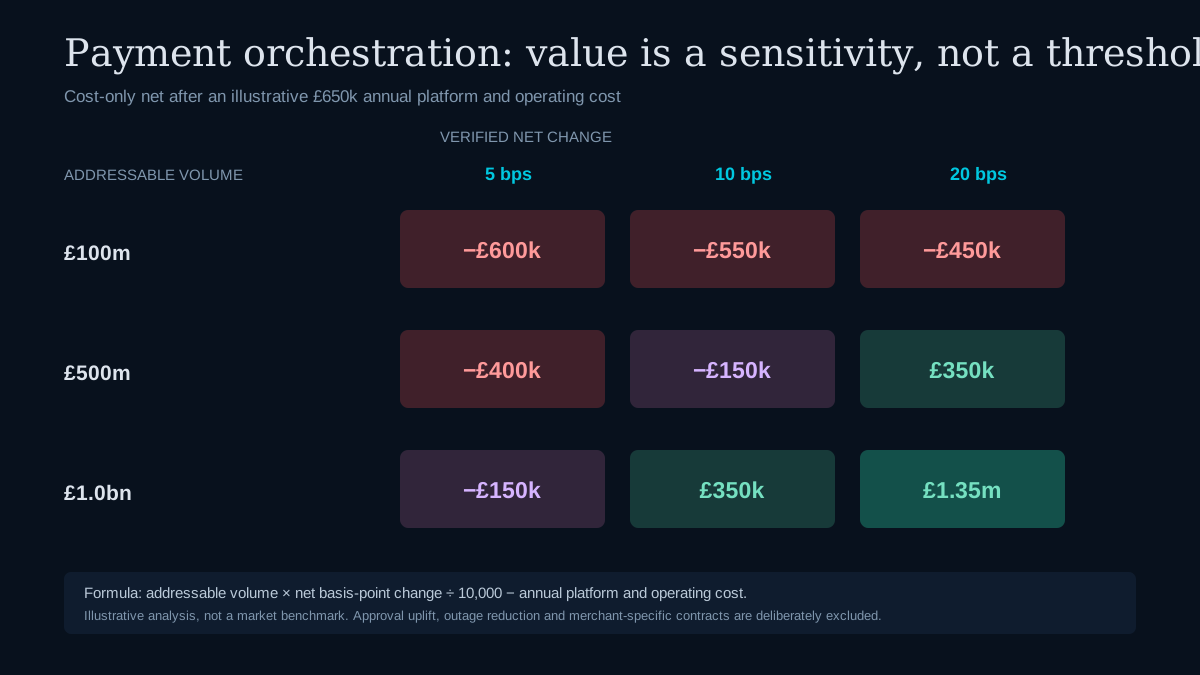
Methodology: CloudFintech applies gross value = addressable annual volume × net basis-point change ÷ 10,000, then subtracts an illustrative £650,000 annual cost. The model excludes approval uplift, outage reduction and taxes. These are scenarios, not market benchmarks or forecasts.
Primary sources: Visa decline-resubmission rules; EMVCo payment tokenisation framework; PCI DSS v4.0.1 publication; PCI SSC FAQ: validation programmes
Download underlying datasetThis model prevents two common errors: applying a saving to total company revenue rather than addressable payment volume, and treating a vendor's gross basis-point claim as a net benefit. Cross-border mix, interchange, scheme fees, foreign exchange, provider minimums and orchestration fees all need consistent treatment.
Build, buy or remain multi-PSP without an orchestrator
Buying is usually strongest when the merchant needs many maintained adapters, rapid market expansion or a vault independent of one processor. The trade-off is an additional vendor in the critical path, platform fees, contractual dependency and limits on how deeply routing logic can be customised.
Building is strongest when payment routing is a material proprietary capability, the merchant already employs a mature payments-engineering team, and unusual workflows cannot be expressed safely in a vendor platform. The cost is not the first API integration. It is continuous scheme changes, provider-version upgrades, monitoring, reconciliation, on-call support, audits and the internal control evidence required over years.
A third option is often ignored: maintain two or three direct processor integrations and switch at a coarse level rather than make a per-transaction decision. For merchants with limited geographies and payment methods, that can deliver redundancy without introducing a general orchestration platform. The architecture should match measured complexity, not an arbitrary volume threshold.
How to evaluate an implementation
Begin with a baseline segmented by market, card type, issuer country, payment method and provider. Record approval rate, response latency, cost per successful payment, retry rate, dispute rate and settlement exceptions. Without a segmented baseline, a routing test can mistake a change in customer mix for platform impact.
Run a controlled migration with explicit rollback. Validate idempotency, late responses, partial captures, refunds, disputes, authentication, token portability and finance reconciliation before shifting material traffic. Compare results on successful payments rather than authorisation attempts alone, because aggressive retrying can inflate attempts without improving completed orders.
Contract review should cover data export, token portability, adapter support, service levels, incident notification, audit rights and exit assistance. The end state is not "one API." It is a governed control plane whose routing decisions, security boundaries and economics can be demonstrated after the fact.
Sources & methodology. Regulatory and control statements are grounded in the EU strong-customer-authentication regulation, Visa's public decline-resubmission rules, EMVCo's tokenisation framework and PCI SSC publications. The cost model is illustrative CloudFintech analysis; it is not a benchmark or forecast and should be replaced with merchant-specific contracts and traffic data.
Sources
Numbered references are anchored to the specific claims they support. Primary documents are preferred wherever available.
- payment-tokenisation framework emvco.com ↩
- decline-resubmission rules usa.visa.com ↩
- strong-customer-authentication regulation eur-lex.europa.eu ↩
- PCI DSS v4.0.1 blog.pcisecuritystandards.org ↩
- tokenisation guidance pcisecuritystandards.org ↩
Frequently asked questions
When does a merchant need payment orchestration?
There is no universal volume threshold. It becomes worth evaluating when multiple providers, markets, payment methods or resilience requirements create measurable operational complexity. Use addressable volume, contracted costs, engineering effort and outage exposure to compare orchestration with simpler multi-PSP arrangements.
Can an orchestrator retry every declined payment through another provider?
No. Card-scheme rules distinguish response categories, and some hard declines must not be reattempted. A safe implementation maps provider responses to scheme-aware retry policy, applies idempotency controls and treats timeouts differently from definitive issuer declines.
Does payment orchestration reduce PCI DSS scope?
It may reduce where card data flows, especially with hosted collection and tokenisation, but it does not automatically remove PCI obligations. Scope depends on the real architecture, responsibilities and validation route. A qualified assessor should confirm the design.
How should routing savings be calculated?
Multiply addressable payment volume by the verified net basis-point change, then subtract platform and operating costs. Measure approval and resilience benefits separately. For example, 10–20 basis points on £500 million is £500,000–£1 million before costs.
Update history
- Updated the PCI DSS source language to v4.0.1 and clarified that payment brands, rather than PCI SSC, set compliance-validation programmes and reporting requirements.
- Rebuilt the article with scheme-aware retry guidance, primary regulatory sources, a corrected cost model, a downloadable nine-case sensitivity table and no unsupported build-volume threshold.