Stablecoins for Treasury Teams: A Practical 2026 Guide
A corridor-by-corridor guide to stablecoin payments for treasury teams, using Bank of Italy cost evidence and a controlled pilot framework.
In this research
Stablecoins can shorten parts of a cross-border payment, but they are not inherently cheaper or faster end to end. A 2026 Banca d'Italia mystery-shopping study[1] tested 200 USDC transfers between Italy and Argentina, Brazil, South Africa, the United Arab Emirates and Japan. Total cost ranged from 0.30% to 8.96%, while the on-chain transfer was usually a small component. The practical treasury question is therefore not "are stablecoins cheap?" but "does this specific route improve total delivered cost, time or availability after every conversion and control?"
Regulation is also uneven. The US GENIUS Act was enacted on 18 July 2025[2], but its substantive regime is not yet operative. MiCA's rules for relevant crypto-assets apply in the EU. Neither framework turns a token into a bank deposit, proves a payment route is lawful in every jurisdiction, or guarantees that the route is economical. Those questions still depend on the exact token, entities, providers, activities and corridor.
What are stablecoins for treasury, and what are they not?
A stablecoin is a crypto-asset designed to maintain a value relative to a reference asset. The legal claim and stabilisation mechanism vary. Some tokens are backed by reserves and offer a defined redemption route; others rely on trading incentives, collateral structures or protocols. A treasury cannot infer reserve quality, redemption rights or insolvency treatment from the word "stablecoin." Its approved-token process has to examine the instrument's terms and the entity that can actually redeem it.
For EU classification, MiCA Article 3[3] defines an e-money token as referencing one official currency. An asset-referenced token is a crypto-asset other than an e-money token that references another value, right or combination, which can include one or more official currencies. That is more precise than the common but incorrect shorthand that an ART always references a basket.
What a stablecoin is not automatically is a bank deposit or cash equivalent. Deposit insurance, redemption rights and insolvency treatment depend on the issuer, token terms and jurisdiction. Accounting classification is a separate analysis again. A treasury policy should therefore identify the legal claim it owns, the redemption route and the approved accounting treatment instead of assigning every fiat-referenced token to "cash."
Where stablecoins may earn a place in treasury operations
Cross-border payment is the use case most often associated with stablecoins, but the whole route matters. End-to-end cost includes funding, purchase spread, transfer fee, sale spread, withdrawal, custody, compliance and exceptions. The Bank of Italy study found no systematic cost advantage: USDC was cheaper than the same-corridor Wise simulation in three routes and more expensive in four, with one route unavailable on Wise. The result varied by direction as well as country.
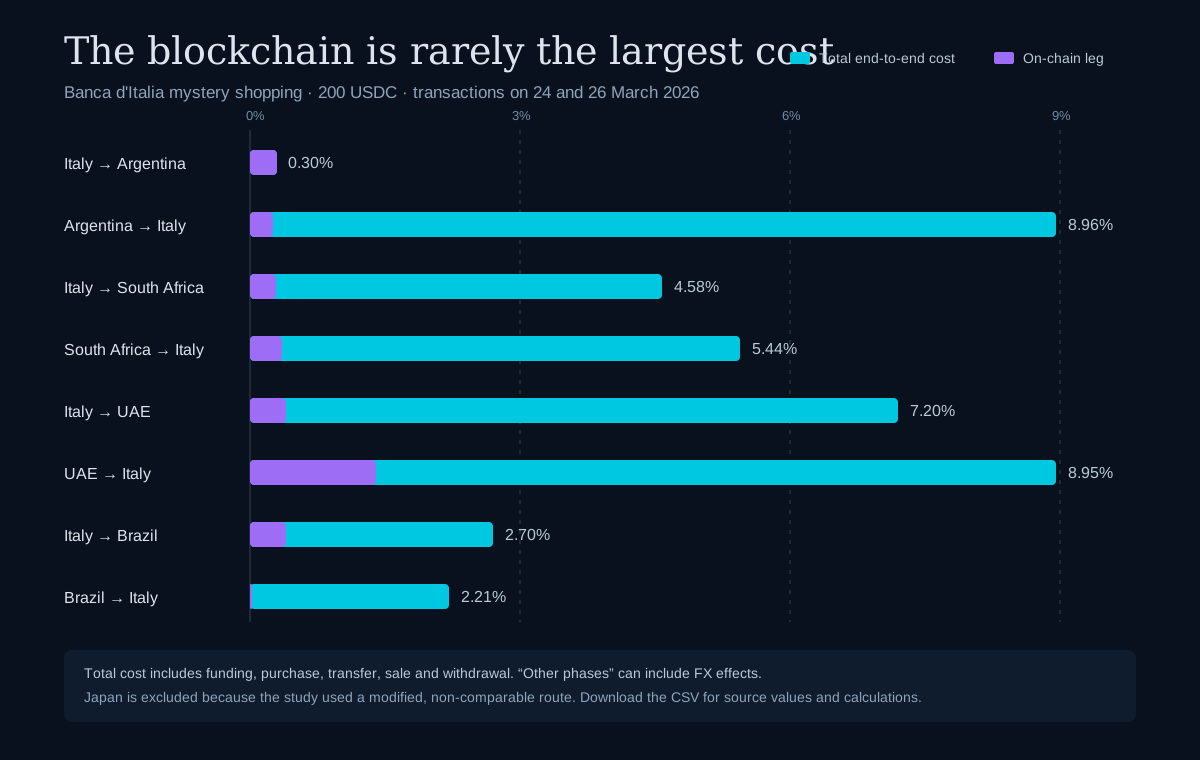
Methodology: CloudFintech transcribed total and transfer-phase percentages from Tables 1 and 3 of Banca d'Italia's 2026 mystery-shopping paper. Other-phases net equals total cost minus on-chain transfer cost. Wise ranges are retained where the paper reported a comparable simulation. Japan is excluded because the authors used a modified route and treated it separately. This is a derived comparison, not a new transaction sample.
Primary sources: Banca d'Italia — Are Stablecoins Efficient for Remittances?; Banca d'Italia — DLT and stablecoins: where do we stand?; BIS Project Agorá findings
Download underlying datasetThe study is evidence, not a universal benchmark. It used one 200 USDC transaction per route, particular exchanges, predominantly Ethereum transfers during low congestion on 24 and 26 March 2026, and Wise simulations collected on 14 April. Japan required a modified route and was analysed separately. Argentina's exchange-rate structure distorted the apparent comparison, while the UAE-to-Italy transaction used card funding because the participant lacked access to a bank account. A treasury should reproduce the measurement with its own provider, amount, time window and operational constraints.
Continuous availability can matter, but it does not split neatly between conventional and tokenised rails: UK Faster Payments[4], TIPS[5] in the euro area and FedNow[6] operate continuously. Many public blockchains are also designed for continuous operation, although congestion, network incidents, exchange availability and off-ramp hours can still interrupt the complete service. The relevant comparison is whether the chosen end-to-end route is available when the business needs it.
Technical accessibility is not legal permission. Before testing a corridor, the business needs documented treatment of the sending and receiving entities, token and service providers, sanctions screening, foreign-exchange or capital-flow rules, licensing, tax and reporting. This guide does not determine whether a stablecoin payment is lawful in any named corridor. If the necessary treatment cannot be established for the actual facts, the route should remain outside the pilot.
A separate institutional use case is settlement of tokenised assets. Conditional delivery-versus-payment can remove principal risk between linked legs when both transfers are legally final, but it does not remove liquidity, replacement-cost, operational or legal risk. Stablecoins are not the only candidate cash leg: BIS Project Agorá demonstrated multi-currency wholesale settlement using tokenised commercial-bank deposits and tokenised central-bank reserves[7]. For treasury teams, tokenised deposits and regulated stablecoins are better treated as potentially competing and interoperable instruments than as one inevitable winner.
The risks a treasurer must price: depeg, reserves and counterparty
Begin with the depeg, because a market-price discount can erase an operational saving. Circle disclosed that USDC traded below one dollar in March 2023[8] after $3.3 billion of its reserves were held at the failed Silicon Valley Bank; the token returned to its peg after US authorities protected the bank's depositors. The episode shows that a token's reserve-bank exposure and redemption confidence can affect its market value during the period a treasury holds it.
Reserve and redemption analysis starts with concrete questions: what backs the token, who holds those assets, what claim does the treasury have, who is eligible to redeem directly, what fees and timing apply, and what disclosures can be independently checked? Congress enacted the GENIUS Act on 18 July 2025, but the OCC describes its effective date as the earlier of 18 January 2027 or 120 days after the primary federal regulators issue final implementing regulations[9]. The OCC rules published in February 2026 were proposed rules. Reserve, redemption and supervisory protections under the future regime must therefore be described in future tense until the effective date is triggered.
The route contains several distinct failure points: the issuer and its redemption process, the blockchain and token contract, the wallet or custodian, and any exchange or off-ramp used to convert. Direct key control creates operational and security responsibilities; using a custodian adds dependence on that provider's solvency, controls and service availability. The control framework therefore separates issuer, chain, custodian and provider limits instead of describing them as one generic "crypto risk."
Operational recovery also differs from conventional payments. A transfer to the wrong address, token contract or chain may not have a bank-style recall or chargeback route; recovery depends on the network, issuer, custodian, exchange and recipient. A pilot can test address allow-lists, independent destination verification, small test transfers and segregated approval before increasing limits. Those controls reduce error probability but do not guarantee recovery.
Accounting and tax: the part that catches treasury teams out
Accounting cannot be inferred from the token's label. FASB ASU 2023-08[10] applies only when every scope criterion is met, including that the asset does not provide the holder with enforceable rights to underlying goods, services or other assets. A stablecoin with contractual redemption rights may therefore require analysis under other US GAAP. The exact token terms and the holder's facts matter.
Under IFRS, there is no dedicated stablecoin standard. The IFRS Interpretations Committee's cryptocurrency agenda decision[11] addressed a narrower class of assets that did not create a contractual right for the holder; a redeemable stablecoin may have different characteristics. Classification therefore turns on the token's enforceable terms, business purpose and the standards that apply to those facts. Written auditor advice should precede the first transaction.
Tax treatment and recordkeeping also depend on jurisdiction and use. Before a pilot, the finance team can define how funding, purchases, fees, transfers, sales and withdrawals map into the ERP and treasury-management system, including timestamps and fiat-equivalent values. The economic comparison should include that reporting and reconciliation workload rather than treating the blockchain fee as the programme's total cost.
Why yield is a separate treasury decision
Payment balances and yield products answer different questions. Lending tokens, depositing them into a protocol or purchasing a yield-bearing instrument changes the counterparties, liquidity assumptions and potential loss mechanisms. The expected return cannot be evaluated as if it were merely a discount on payment fees.
Yield changes the risk analysis. Lending into a protocol adds smart-contract, borrower, liquidity and governance exposure that is absent from a prompt payment-and-conversion flow. Once the GENIUS Act regime becomes effective, a permitted payment-stablecoin issuer will be restricted from paying interest or yield solely in connection with holding, using or retaining the token. A yield offered by another product or intermediary is not automatically equivalent to issuer-paid interest and needs its own legal, accounting and investment analysis.
A tokenised money-market fund is a different product again: it is an investment rather than a payment token and should pass through the organisation's investment governance. Keeping investment assets separate from settlement balances makes the mandate, liquidity expectation and risk owner explicit. The programmable infrastructure may look similar, but the economic and legal claims are not interchangeable.
Regulatory snapshot: effective EU rules and future US implementation
In the United States, the GENIUS Act creates a federal framework but ties effectiveness to elapsed time or final implementing regulations. Until that trigger occurs, the Act's future reserve, redemption, disclosure, supervision and permitted-issuer requirements should not be presented as current protections. A treasury can track rulemaking and effective dates while assessing the protections that apply to its chosen issuer today.
In the European Union, MiCA distinguishes EMTs from ARTs using the Article 3 definitions described above. The classification changes the applicable issuer, reserve and redemption provisions; it is not a quality label. A treasury should verify the token's classification, issuer authorisation and holder rights using the regulator's records and the instrument's own terms rather than relying on a platform label.
Issuer regulation is only one layer. The transaction may also engage payment-services, sanctions, financial-crime, foreign-exchange, tax, data and reporting rules in the relevant jurisdictions. The control matrix below treats documented corridor eligibility as a gate and avoids claiming that one US or EU classification resolves the whole transaction.
A decision framework: should your treasury hold or transact in stablecoins?
Separate transacting from holding. Receiving or purchasing a token for a defined payment and converting promptly can reduce the duration of issuer and depeg exposure. Maintaining an operating balance over days or weeks creates a continuing exposure that needs a separately approved purpose, limit, accounting treatment and exit plan. Adding yield creates another product decision again.
The downloadable framework organises twelve questions into four gates: corridor eligibility; issuer, holder claim and redemption; custody and operational control; and end-to-end economics with a conventional-rail fallback. It is a template, not a legal threshold. Each organisation needs to replace the examples with approved criteria for its own entity, token, provider, counterparty and corridor.
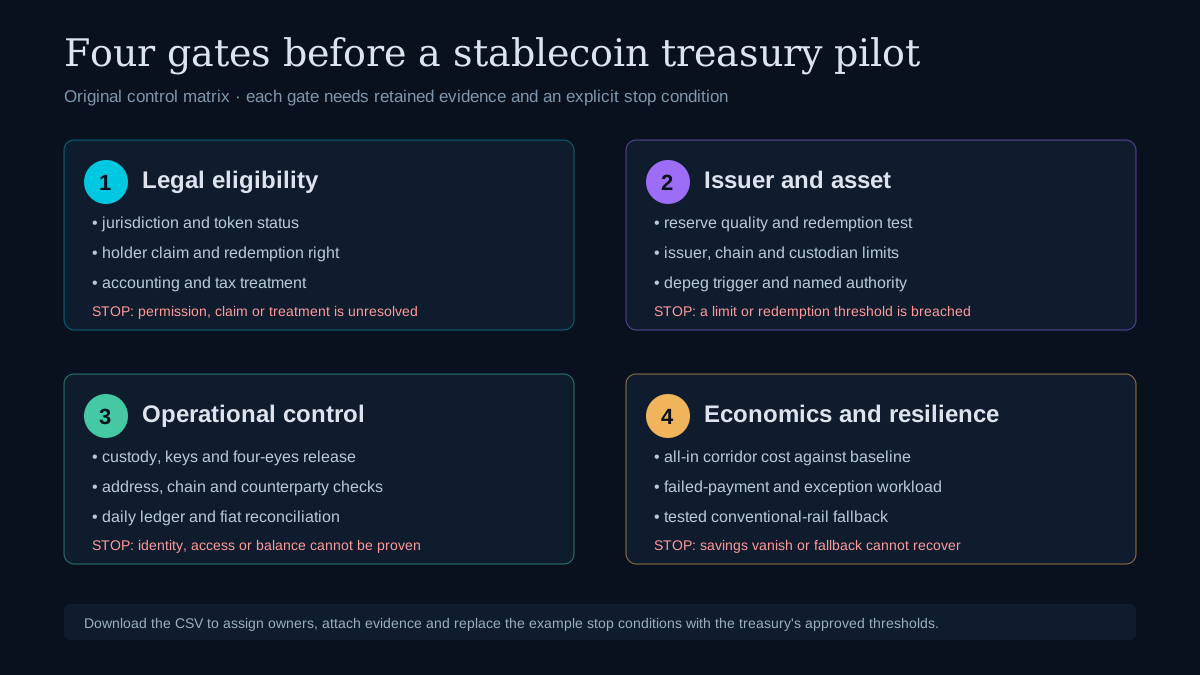
Methodology: CloudFintech translated the article's legal, issuer, operational and route-economics analysis into a stage-gated control matrix. The questions and stop conditions are editorial decision prompts, not legal thresholds. Teams should replace them with approved entity-, token- and corridor-specific criteria.
Primary sources: Regulation (EU) 2023/1114 (MiCA); US GENIUS Act — Public Law 119-27; CPMI stablecoin cross-border considerations; IFRS cryptocurrency agenda decision
Download underlying datasetThe same diligence instinct that treasuries apply to a new banking relationship should apply to the technology stack behind a stablecoin programme. The decision to settle on-chain sits alongside the wider modernisation of payments infrastructure described in our cloud-core migration playbook. A treasurer is wiring a new rail into an existing payments operation, and it should be governed with the same rigour as any other payment channel: supplier onboarding, payment approvals, reconciliation and a kill switch.
A controlled pilot can pre-register the route, amount, comparison provider, cost components, service threshold, exposure ceiling and stop conditions. Recording every funding, conversion, transfer, withdrawal, failed-payment and reconciliation event makes it possible to test whether the apparent saving survives FX, provider fees and operational workload. Expansion then becomes an evidence-based corridor decision rather than a general bet on stablecoins.
Sources & methodology. Corridor figures reproduce Tables 1 and 3 of Banca d'Italia's 2026 mystery-shopping study. CloudFintech calculated "other phases, net" as total cost minus the reported on-chain transfer cost and created the comparison chart; it did not conduct new transfers. Regulatory descriptions use Public Law 119-27, the OCC's February 2026 proposed-rule bulletin and MiCA Article 3. Accounting scope uses FASB ASU 2023-08 and the IFRS Interpretations Committee agenda decision. This is an operational research framework, not financial, legal, accounting or tax advice. CloudFintech is an AI-assisted publication edited under the standards at editorial standards.
Sources
Numbered references are anchored to the specific claims they support. Primary documents are preferred wherever available.
- Banca d'Italia mystery-shopping study bancaditalia.it ↩
- GENIUS Act was enacted on 18 July 2025 govinfo.gov ↩
- MiCA Article 3 esma.europa.eu ↩
- UK Faster Payments wearepay.uk ↩
- TIPS ecb.europa.eu ↩
- FedNow frbservices.org ↩
- BIS Project Agorá demonstrated multi-currency wholesale settlement using tokenised commercial-bank deposits and tokenised central-bank reserves bis.org ↩
- Circle disclosed that USDC traded below one dollar in March 2023 circle.com ↩
- OCC describes its effective date as the earlier of 18 January 2027 or 120 days after the primary federal regulators issue final implementing regulations occ.gov ↩
- FASB ASU 2023-08 storage.fasb.org ↩
- cryptocurrency agenda decision ifrs.org ↩
Frequently asked questions
Are stablecoin payments cheaper than bank transfers?
Not systematically. Banca d'Italia's 2026 test found total costs from 0.30% to 8.96% for 200 USDC transfers. USDC beat a same-corridor Wise simulation in three routes and cost more in four. The result depended on direction, provider, funding method, FX and withdrawal, not merely the blockchain fee.
Where do most stablecoin remittance costs arise?
In the Bank of Italy exercise, the on-chain transfer averaged about 0.4% and was usually a small part of total cost. Funding, purchase and sale spreads, withdrawal charges and domestic payment infrastructure caused most of the variation.
Is the US GENIUS Act already in effect?
Its substantive regime was not yet operative when this guide was updated. The OCC states that the effective date is the earlier of 18 January 2027 or 120 days after the primary federal regulators issue final implementing regulations. Rulemaking and the effective-date trigger should be checked again before relying on the future framework.
Are tokenised bank deposits competitors to stablecoins?
They can be both competitors and complements. Tokenised deposits may suit bank-led wholesale settlement, while regulated stablecoins may offer broader distribution or continuous availability. Interoperable systems could use both; BIS Project Agorá demonstrated tokenised commercial-bank deposits settling with tokenised central-bank reserves.
Should a corporate treasury hold stablecoins or only transact in them?
The decisions should be governed separately. A prompt payment-and-conversion flow limits the duration of issuer and depeg exposure. A continuing balance needs its own approved purpose, exposure limit, accounting treatment and tested exit route; a yield product adds a further investment decision.
Update history
- Rebuilt the guide around Banca d'Italia's corridor evidence; removed the capital-controls recommendation; corrected MiCA ART and GENIUS Act timing; clarified accounting scope; and added a downloadable cost-decomposition dataset and chart.
- Clarified that stablecoins are not automatically deposits or cash equivalents, added primary IFRS context, reframed payment savings as an end-to-end corridor test and added a downloadable 12-control pilot matrix.