AML Transaction-Monitoring Economics: A Cost and Evidence Model
A practical model for measuring AML transaction-monitoring workload without confusing fewer alerts with better controls.
In this research
Transaction monitoring is often discussed as an alert-volume problem. That framing is convenient for budgets and vendor demonstrations, but it is too narrow for a control owner. A smaller queue can reflect better data, clearer segmentation and well-tested scenarios. It can also reflect missing feeds, thresholds set too high, weak investigation records or a process that cannot show why a case was closed.
A more useful question is: what does it cost to produce a reviewable decision, and what evidence shows that the monitoring process still fits the firm’s risk? This article provides a practical worksheet for answering it. It is not legal advice, a universal control checklist or a vendor comparison. A firm's obligations and operating design depend on its jurisdiction, regulated activity, customer base, products and risk assessment.
What ongoing monitoring is meant to achieve
For a UK business relationship, ongoing monitoring includes scrutinising transactions to see whether they are consistent with what the firm knows about the customer, their business and risk profile, as well as keeping customer-due-diligence records current. HMRC’s current guidance also identifies changes in circumstances, unusual activity, high-risk-country changes and doubts about existing information as triggers for action. HMRC’s ongoing-monitoring guidance[1]
That purpose matters because a transaction-monitoring system is only one component. It needs a defined population, usable customer and transaction data, a risk rationale, accountable review, escalation routes and a way to test whether changes improved or weakened coverage. A dashboard showing fewer alerts does not by itself answer any of those questions.
HMRC’s supervision handbook asks practical questions that are useful for any control-design workshop: when and how transactions are scrutinised, who is responsible, what happens when risk changes, and how frequency, volume, size, activity pattern and geography are considered. The intensity of monitoring should follow the business’s risk assessment rather than one calendar-driven review cycle for every customer. HMRC Economic Crime Supervision Handbook[2]
Why alert count is not a cost model
Alert count measures a workflow entry point, not the work required to reach a defensible outcome. Two teams can receive the same number of alerts and have very different operating demands. One may receive enriched cases with customer context, linked counterparties, transaction history and a clear trigger. Another may need to repair identifiers, chase missing records and manually reconstruct activity across systems before an investigator can even begin.
Nor is a closure rate a quality score. A high closure rate could be appropriate where scenarios deliberately cast a wide net and triage is well evidenced. It could also indicate that reviewers lack the context, time or escalation support needed to investigate. The right interpretation needs evidence about segmentation, data coverage, reviewer decisions, quality assurance and later feedback, not a global percentage.
The Financial Action Task Force describes the risk-based approach as a way to focus resources where risks are higher and to apply proportionate measures where they are lower. It does not prescribe one technology or one threshold. Its high-level guidance also stresses periodic review of monitoring thresholds and systems, with documented results. FATF banking-sector risk-based guidance[3]
The CloudFintech workload and evidence model
The model below separates the operating stages that a single alert-count KPI hides. It does not supply market benchmarks. Instead, a reader replaces every input with their own measured volumes, handling times and fully loaded role costs, then keeps the assumptions fixed when comparing two periods or two proposed changes.
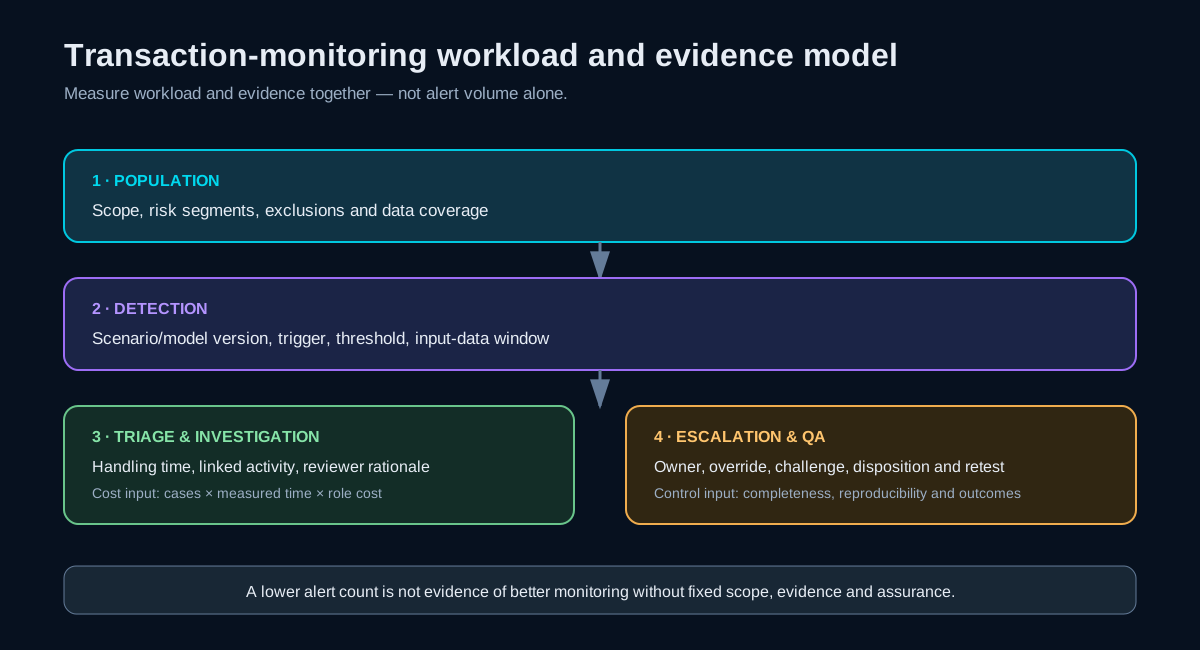
Methodology: CloudFintech created this original worksheet from the monitoring and documentation themes in HMRC, FATF and FCA material. Every volume, handling time and cost is an illustrative input supplied by the reader; the model is not a market benchmark, legal checklist or prediction of detection quality.
Primary sources: HMRC ongoing monitoring guidance; HMRC Economic Crime Supervision Handbook; FATF risk-based approach for the banking sector; FCA sanctions systems and controls findings
Download underlying datasetThe downloadable worksheet starts with the monitored population rather than the number of alerts. Record which relationships or transactions are in scope, which feeds are missing or delayed, and which segments are subject to different scenarios or thresholds. That creates a denominator for interpreting a change. If a product migration removes a feed, a falling alert count could be a data-coverage failure, not an efficiency gain.
For one fixed period, calculate reviewer hours as alerts routed to triage × measured average triage time. Calculate investigation, quality-assurance and escalation hours in the same way. Add technology, data and change-control cost only after identifying the owner and observation period. The resulting total is an operating-cost estimate, not a measure of money-laundering risk or regulatory compliance.
When testing a new scenario, model or threshold, compare the baseline and test using the same population definition, risk segments, decision rules and QA sample. Report both workload and evidence completeness: source-data availability, reason codes, linked activity, reviewer rationale, overrides, escalation decisions and subsequent QA results. A lower cost is useful only if those control signals remain intelligible.
Where cost really moves
Detection and enrichment. A rule, model or trigger can generate a case in seconds, but a decision often depends on data assembled elsewhere. Customer information, beneficial ownership, payment context, prior alerts, counterparties and source-of-funds records may sit in different systems. Measure enrichment separately from reviewer judgement so a team can see whether its constraint is a scenario, a data contract or a case-management workflow.
Triage. Triage should make the next accountable action clear: close with documented rationale, request more evidence, investigate, restrict activity where authorised, or escalate. The case record should preserve the trigger, the version of any scenario or model, the data time window, the reviewer and the disposition. Without that lineage, a firm cannot reliably challenge a change or explain why similar cases were handled differently.
Investigation and escalation. The costliest cases are not necessarily the highest-value transactions. They are often the ones with incomplete records, difficult entity resolution, cross-border context or repeated changes in customer behaviour. A team should distinguish a case requiring additional CDD from a case requiring a formal internal escalation. An alert is an input to analysis; it is not a finding of wrongdoing and it is not, by itself, a legal reporting decision.
Quality assurance and change control. Any promised optimisation has a maintenance cost. Threshold changes, new typologies, model releases, data-source changes and investigator feedback need challenge, documentation and retesting. FATF’s risk-based principles distinguish the risk-based identification of suspicious activity from the reporting obligation that arises once the relevant legal suspicion threshold is met. FATF high-level principles[4]
Evidence a control owner should be able to retrieve
A defensible programme can show which customers and transactions were in scope, why particular monitoring logic applied, what information the reviewer saw and who made each decision. It can also show exceptions: missing feeds, failed matching, manual overrides, out-of-date CDD, reopened cases and rule or model changes. This is more valuable than claiming an abstract "AI-powered" monitoring capability.
Recent FCA findings on sanctions systems are not a substitute for AML rules, but they are a useful reminder that firms need to understand inherent and residual risk, control effectiveness, data analysis, thematic review and intelligence-led investigation. The FCA also describes an example in which transaction monitoring surfaced a repeat payment involving the same counterparties. FCA sanctions systems and controls findings[5]
For monitoring operations, the practical implication is to preserve the evidence that joins an alert to a customer, their risk profile and the later case decision. A dashboard may aggregate volumes for management, but the underlying record must be detailed enough for QA, internal challenge and the firm’s applicable supervisory obligations.
How to test an optimisation without losing assurance
Start with a bounded segment: a product, customer cohort or payment type with known data quality and an accountable owner. Freeze the baseline population, scenarios, thresholds and review rules. Document the known gaps before changing anything; otherwise a later comparison will mistake a coverage change for improved performance.
Next, run the proposed change alongside the existing process for a defined period. Compare the cases each approach creates, the evidence attached, reviewer and QA outcomes, overrides and unresolved data issues. Do not use a retrospective "fewer alerts" result as the sole decision criterion. Investigate material differences, especially cases the new approach did not surface or could not explain.
Finally, approve, amend or roll back through an accountable governance route. The retained record should identify what changed, why it was approved, the results of testing, limits of the conclusion and the next review point. That turns monitoring economics into a control decision rather than a procurement claim.
For a wider buyer framework covering identity, monitoring, screening, case management and resilience, see CloudFintech’s RegTech capability map. The useful goal is not the fewest possible alerts. It is a proportionate process that directs effort to higher-risk activity while leaving a complete, reviewable evidence trail.
Sources
Numbered references are anchored to the specific claims they support. Primary documents are preferred wherever available.
- HMRC’s ongoing-monitoring guidance gov.uk ↩
- HMRC Economic Crime Supervision Handbook gov.uk ↩
- FATF banking-sector risk-based guidance fatf-gafi.org ↩
- FATF high-level principles fatf-gafi.org ↩
- FCA sanctions systems and controls findings fca.org.uk ↩
Frequently asked questions
What is the best KPI for AML transaction monitoring?
There is no single best KPI. Track workload alongside coverage and evidence quality: population in scope, data completeness, alert reasons, triage and investigation time, QA findings, overrides, escalations and outcomes. A lower alert count alone does not establish better detection.
Can a model decide whether an AML alert should be reported?
A model or rule can prioritise a case and assemble relevant evidence, but reporting decisions depend on applicable law, the facts available and an accountable human process. An alert is not itself proof of wrongdoing or an automatic reporting outcome.
How should a firm compare two monitoring scenarios?
Use the same monitored population, data window, risk segments, decision rules and QA approach. Compare workload and case evidence as well as alert volumes, then investigate material differences in what each scenario surfaced or missed.
Why are false-positive rates not enough to assess monitoring?
A single rate does not reveal data gaps, risk coverage, decision quality or whether reviewers could reconstruct a case. Its meaning depends on the scenario’s purpose, the customer segment, escalation policy and the evidence available to reviewers.
What evidence should be retained for an AML monitoring alert?
Retain the triggering logic and version, relevant data window, customer and transaction context, linked activity, reviewer rationale, disposition, overrides, escalation decisions, QA results and records of later scenario or model changes.
Update history
- Published as an original workload-and-evidence framework for AML transaction monitoring, with reader-supplied illustrative inputs rather than market benchmarks.