AI in Financial Services 2026: The Complete Map
A function-by-function map of where AI is actually deployed across banking and finance in 2026, and why the durable value sits in the back office, not the demo-stage chatbot.
In this research
AI in financial services is often discussed through conversational front-office assistants, but established uses also include fraud scoring, transaction-monitoring support and document extraction. These systems are typically deployed alongside rules, human review and other controls; their value and risk depend on the task, the data and the operating controls. This is a map of common production uses, with named institutions where a deployment is publicly documented, and an account of the associated limitations.
The distinction that organises this piece is not old AI versus new AI, nor good versus bad. It is whether a model's output is checked before anyone acts on it. Where a human or a downstream control catches a wrong answer, AI is deployed widely and works well. Where the output reaches a customer or a market unmediated, deployment is cautious, narrow, and heavily gated, and rightly so. Hold that test in mind and almost every adoption pattern below falls into place.
What is AI in financial services?
AI in financial services covers a spectrum of statistical and machine-learning techniques applied to the core jobs a bank, insurer, or payments firm does: deciding who to lend to, spotting fraud and laundering, serving customers, pricing and trading instruments, advising on wealth, and producing the reams of regulatory paperwork the sector runs on. Most of it is not new. Gradient-boosted decision trees have scored credit and fraud risk for the better part of a decade, and gradient boosting still does more useful work in a bank than any large language model.
What changed from roughly 2023 onwards is the arrival of generative models that can read and write unstructured text and code. That shift expanded the addressable surface: suddenly a model could draft a suspicious-activity narrative, summarise a 200-page prospectus, or answer a customer in plain English. But generative capability also imported a new failure mode the sector had largely engineered out: confident fabrication. A boosted tree that scores a loan does not invent a number; a language model asked for advice can hallucinate one. That distinction runs through everything below.
It helps to separate three layers that get bundled together in vendor pitches. Predictive ML has long been used to score risk. Generative AI can assist grounded tasks, such as summarising supplied documents or extracting fields from forms, where outputs can be checked against the source. It can also answer open questions from model memory, where hallucination risk is more acute. Neither category is inherently safe: each needs task-specific validation, security controls and appropriate human oversight.
Credit underwriting: real, regulated, and quietly transformed
Lenders have leant on machine learning longer here than almost anywhere else, and the generative wave barely touched the part that matters. ML models have scored default risk, priced loans, and automated decisions on thin-file and near-prime applicants for some time. The recent change is speed and reach: pulling open-banking[1] transaction data and alternative signals to decide applications that a manual analyst would have taken days to clear. We covered the mechanics of this in our deep-dive on AI underwriting, and the short version is that the decision latency has genuinely collapsed for a large share of consumer and small-business lending.
What is real: automated affordability assessment, instant pre-approval, fraud-aware income verification, and risk-based pricing at the point of application. What is mostly demo-hype: the idea that a large language model "reasons" its way to a credit decision. The production models are still discriminative classifiers tuned for stability and explainability, because regulators demand both. Adverse-action reasons have to be defensible, and a model whose logic cannot be reconstructed is a liability rather than an asset.
Bias is a material risk: a model trained on historical lending data can reproduce patterns of discrimination, and proxy variables may correlate with protected characteristics. The EU AI Act[2] classifies qualifying creditworthiness assessment and credit scoring of natural persons as Annex III high-risk. Following the 2026 Digital Omnibus amendment[3], the core Annex III high-risk requirements apply from 2 December 2027. Affected firms can prepare their data governance, documentation, human-oversight and testing arrangements now, but should not present those delayed requirements as already operative.
Fraud detection and AML: the back office that became the front line
If you want the single most durable AI deployment in finance, look at fraud and anti-money-laundering. Card networks and banks have run real-time fraud scoring for years; the models weigh hundreds of features per transaction and approve or decline inside the authorisation window. Mastercard's Decision Intelligence[4] and similar network-level systems are production infrastructure, not pilots. This is AI nobody photographs because there is nothing to photograph: it is a score, returned in milliseconds, that stops a fraudulent purchase before the cardholder notices anything happened.
Transaction monitoring for money laundering is the other half, and it is where the economics are most punishing. The legacy approach (static rules that flag every transfer over a threshold) drowns compliance teams in false positives, the overwhelming majority of which are noise. Machine-learning monitoring re-ranks and prioritises alerts so analysts spend time on the cases that matter, and a growing number of institutions now use models to draft the suspicious-activity report narrative itself. That is a legitimate generative use: the human still investigates and signs, but the model assembles the first draft from the case file, turning an hour of writing into a few minutes of editing.
The risk profile is more favourable than in credit, because the human-in-the-loop is structural rather than bolted on. An analyst reviews flagged cases; a false positive costs time, not a wrongful denial of service in most workflows. The genuine danger is the inverse: over-trusting a model that has learned to wave through a new laundering typology it never saw in training. Adversaries adapt deliberately, probing for the patterns a model has learned to ignore, so a monitoring model that is not continuously retrained degrades faster than almost any other model in the bank. We mapped the broader tooling stack here in our guide to the RegTech stack.
Customer service: the front-office demo that flatters to deceive
This is where hype and reality diverge most sharply. Every bank can show you a conversational assistant. Far fewer will let it do anything consequential without a human gate. There is a reason for the caution, and it has a name in the public record.
In 2024 a Canadian tribunal held Air Canada liable for a refund its website chatbot had described inaccurately[5], rejecting the argument that the chatbot was a separate entity for which the airline bore no responsibility. That case is cited across financial services compliance functions because it crystallises the exposure: if your assistant tells a customer something wrong about a regulated product (a rate, a fee, an eligibility rule), the firm owns the consequence. In a sector governed by consumer-duty and fair-treatment obligations[6], that is a serious liability, not a UX footnote. The legal principle is simple: an automated agent does not shield the firm from liability, it speaks for the firm to the customer.
Useful customer-service applications can include routine account queries, summarising customer history for a human agent and drafting responses for approval. Fully autonomous answers on regulated products require careful design, testing and accountability because an inaccurate rate, fee or eligibility statement can harm a customer. Many firms therefore use generative tools as augmentation, with defined permitted questions, approved content and escalation routes, rather than treating a chatbot as an independent decision-maker.
Markets and trading: AI everywhere, generative AI almost nowhere near the trade
Plenty of the machine learning in markets is decades old and entirely uncontroversial: execution algorithms, signal generation, and market-making have used statistical models for years. The 2026 story is not that generative AI started picking trades. It is that large language models entered the research and surveillance layers around the trade. JPMorgan says its internal LLM Suite reached 200,000 users within eight months[7]. The bank describes it as a secure general-purpose assistant; that public account supports the scale of adoption, not a claim that it executes trades.
The separation between analysis and execution matters. A firm considering generative tools near an order workflow needs controls proportionate to the use case, including testing, access limits, monitoring and clear accountability. Publicly discussed uses include research, internal assistance and trade surveillance, where models can flag potential market-abuse patterns across communications and order flow for a compliance human to investigate.
The risk in markets is unusual because it is systemic rather than local. If many desks lean on similar models trained on overlapping data, they may crowd into the same positions and amplify a move, a model-driven version of herd behaviour, where the very thing that makes each firm's model good makes the system as a whole fragile. Regulators have flagged this dimension, and it is the one AI risk in finance that is genuinely macro rather than firm-level. A bias in a single bank's credit model harms that bank's applicants; a correlated failure across the market's trading models can move prices for everyone.
Wealth management and robo-advice: where hallucination is most dangerous
Robo-advisers are real and have been for over a decade: Betterment, Wealthfront, and the platforms inside incumbents like Vanguard and Schwab automate portfolio construction and rebalancing against a risk profile. That part is rules-based, suitability-tested, and well understood. None of it depends on generative AI, and it is worth saying plainly that the established robo-advice industry and the new generative co-pilot are different technologies that happen to share a marketing category.
The new and genuinely hazardous frontier is the generative "financial co-pilot" that answers free-text questions about a customer's money. Investment advice is a regulated activity; a model that hallucinates a tax rule, misstates a product's risk, or nudges a customer towards an unsuitable allocation is not a quirky bug but a potential breach. This is the single worst place in financial services to deploy an unconstrained language model, because the failure mode is uniquely toxic: the wrong answer is plausible, personalised, confidently stated, and acted upon with real money the customer may not recover.
What firms actually ship, sensibly, is constrained. Answers are retrieval-grounded, limited to a customer's own holdings and the firm's approved content, with hard guardrails against anything that resembles a personal recommendation and a clear handoff to a human adviser at the boundary. The durable value is operational (freeing advisers from admin so they spend more time with clients) far more than it is the customer-facing oracle the demos imply. The firms moving fastest here are not the ones with the cleverest chatbot; they are the ones that have worked out exactly which questions the model is allowed to answer and built a wall around everything else.
Regulatory reporting and the back office: the unglamorous heart of the value
Here is the thesis, stated plainly. The most durable, defensible AI value in financial services in 2026 sits in regulatory reporting, document processing, reconciliation, and the broader back office, precisely the work no one demos because it photographs as a spreadsheet.
Consider what the back office actually does: extract data from unstructured documents such as KYC files, loan packets and insurance claims, reconcile mismatched ledgers, classify and route transactions, and assemble regulatory submissions. These are bounded, high-volume, verifiable tasks: exactly what machine learning and constrained generative extraction do well, and where a wrong answer is caught by a downstream check rather than delivered to a customer as advice. Document AI that reads a passport and a bank statement to onboard a customer is mundane and enormously valuable. KYC and AML remediation, where models pre-fill case files for human review, is where banks are redeploying headcount away from rote data entry and towards judgement.
Grounding a model in supplied documents can make outputs easier to check, but it does not remove the need for validation, access controls or human review. Reporting and back-office automation may use both extraction and generative tools, with the appropriate controls depending on the workflow. Clean, accessible and well-structured data can support more reliable implementation, but data foundations are one of several constraints alongside process design, model governance and integration.
Model risk, governance, and the rules that now bind
None of the above ships without governance, and 2026 is the year the governance stopped being optional. Model risk management (the discipline of validating, monitoring, and documenting every model a bank relies on) long predates AI; US supervisory guidance on model risk[8] has shaped bank practice for years, and that same machinery now has to absorb generative models that drift, hallucinate, and resist conventional back-testing. A boosted tree can be validated against a holdout set with a stable, reproducible result. A large language model that answers slightly differently each time, and whose behaviour can shift with a vendor update, breaks the assumptions that decades of validation practice were built on.
The EU AI Act is an important external framework. Its risk-tiered structure places qualifying creditworthiness assessment and credit scoring of natural persons, as well as risk assessment and pricing in life and health insurance, in the high-risk category. The Act entered into force in 2024, but its application is phased. The 2026 Digital Omnibus sets 2 December 2027 for the core Annex III high-risk requirements, so firms should distinguish current obligations from preparation for that date.
The under-discussed governance gap is third-party and vendor risk. Most banks do not train their own foundation models; they consume them through a handful of providers, which concentrates dependence on a small number of external systems whose behaviour can change with a version update the bank never requested. A model whose behaviour shifts between versions without warning is a validation nightmare, because the artefact you certified is not the artefact running in production a quarter later. The institutions handling this well are versioning aggressively, pinning the exact model build behind any regulated workflow, keeping a deterministic fallback for anything customer-facing, and refusing to let a model touch a regulated decision without a named human who can be held accountable for it.
That discipline, not the size of the model, not the cleverness of the demo, is what will separate the banks that compound an advantage from AI over the next few years from the ones that book a headline pilot and a quiet retreat. The winners will look boring from the outside: better fraud rates, faster onboarding, fewer compliance backlogs, none of it photogenic. The losers will have a press release about an AI assistant and, eighteen months later, a terse line in the risk committee minutes about why it was scaled back. The next competitive frontier is not a smarter chatbot. It is the unglamorous engineering of governance that lets a bank deploy AI into the places it actually pays, and prove to a regulator, after the fact, exactly what the model did and why.
Sources & methodology. This piece draws on the EU AI Act[2], the 2026 Digital Omnibus amendment[3], long-standing US model-risk-management supervisory guidance, and the Bank of England/FCA AI survey[9]. It also cites publicly reported deployments including Mastercard Decision Intelligence, JPMorgan's publicly disclosed LLM Suite rollout and the 2024 Air Canada chatbot ruling. No proprietary performance figures are claimed; use-case descriptions are not universal adoption or safety claims. CloudFintech is an AI-assisted publication edited under the standards at editorial standards.
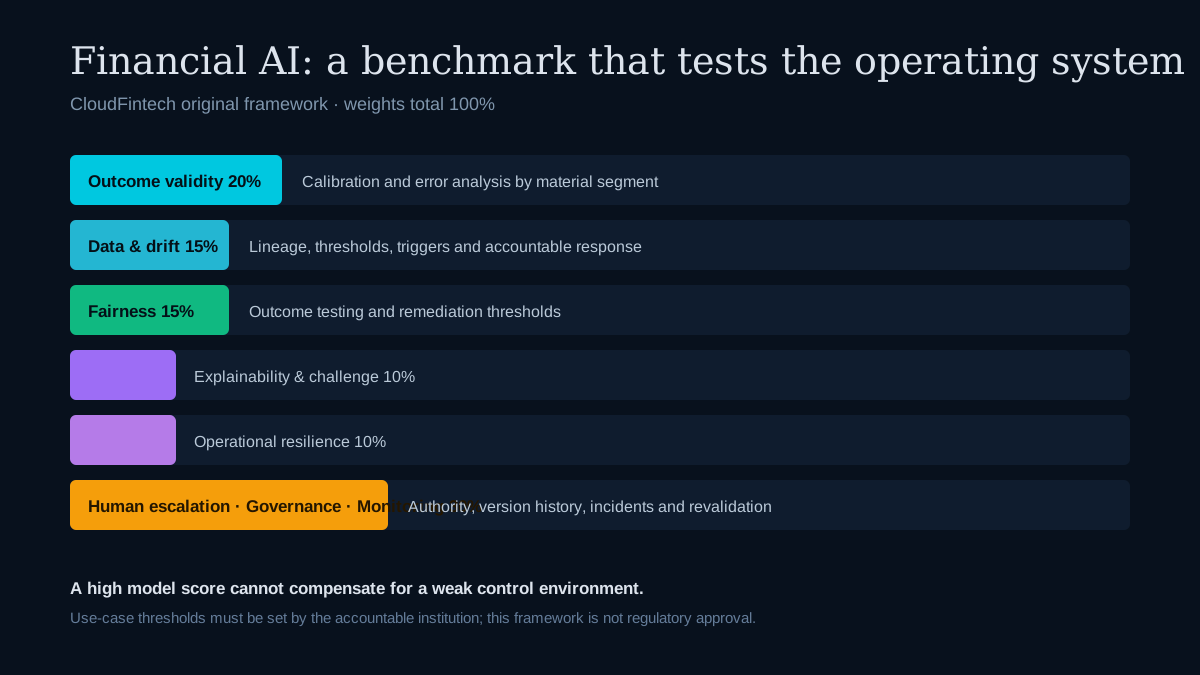
Methodology: CloudFintech translated risk-management outcomes into a procurement and assurance scorecard. The weights are editorial judgement for comparison, not regulatory thresholds or approval.
Primary sources: NIST AI Risk Management Framework 1.0; Federal Reserve SR 11-7 model risk guidance; Regulation (EU) 2024/1689 (AI Act)
Download underlying datasetSources
Numbered references are anchored to the specific claims they support. Primary documents are preferred wherever available.
- open-banking openbanking.org.uk ↩
- EU AI Act eur-lex.europa.eu ↩
- 2026 Digital Omnibus amendment eur-lex.europa.eu ↩
- Mastercard's Decision Intelligence emerj.com ↩
- held Air Canada liable for a refund its website chatbot had described inaccurately mccarthy.ca ↩
- consumer-duty and fair-treatment obligations fca.org.uk ↩
- 200,000 users within eight months jpmorganchase.com ↩
- US supervisory guidance on model risk federalreserve.gov ↩
- Bank of England/FCA AI survey bankofengland.co.uk ↩
Frequently asked questions
Where is AI actually deployed in financial services in 2026?
AI is used across credit underwriting, fraud detection, AML transaction monitoring, customer service, trading research, wealth management and back-office workflows. The mix of production uses varies by firm and market; each use needs controls appropriate to the decision, customer impact and data involved.
Does the EU AI Act classify credit scoring as high-risk?
Yes. The EU AI Act classifies qualifying creditworthiness and credit-scoring systems for natural persons as Annex III high-risk. Following the 2026 AI Omnibus, the core Annex III high-risk requirements apply from 2 December 2027, so affected firms are preparing now rather than treating those duties as already operative. The exact obligations and scope depend on the system and the applicable provisions.
Why is generative AI risky in financial advice?
Because language models can hallucinate, producing plausible but false statements. In regulated advice contexts, a fabricated tax rule or misstated product risk can constitute a breach, and the customer may act on it with real money. Firms mitigate this by grounding answers in approved data and gating recommendations behind human advisers.
Is AI fraud detection real or hype?
Real. Card networks and banks have run real-time machine-learning fraud scoring for years: systems like Mastercard's Decision Intelligence return a risk score within the authorisation window. It is the most established and durable AI deployment in finance, precisely because it operates invisibly in the back office rather than as a demo.
Update history
- Updated the EU AI Act timing following the 2026 Digital Omnibus and narrowed unsupported claims about rules engines, grounded generative AI and data-foundation sequencing.
- Replaced secondary reporting on JPMorgan's LLM Suite with the bank's primary account, clarified what that source establishes, and added a downloadable financial-AI benchmark framework.
- Corrected and re-sourced regulatory and deployment claims during the full fabrication audit.